Description
Robotic Welding Machine
As global manufacturing shifts toward automation, robotic welding machines have become an indispensable tool for factories seeking operational upgrades. They address the common pain points of traditional manual welding, such as skilled welder shortages, inconsistent weld quality, low production efficiency, and safety hazards in harsh working conditions. Our robotic welding machine integrates a high-precision 6-axis robotic arm, advanced digital welding power supply, and intelligent control systems, delivering flexible, reliable, and cost-effective welding solutions for manufacturers of all sizes worldwide. Industry data indicates that 32% of industrial production utilized intelligent welding robots in 2026, and our equipment stands out for its user-friendliness, multi-process compatibility, and quick setup. It helps businesses reduce operational costs, improve product qualification rates, and maintain competitiveness in the global market. Whether for large-scale mass production or small-batch custom work, this equipment adapts seamlessly to diverse welding requirements, making it essential for enterprises transitioning to smart manufacturing.
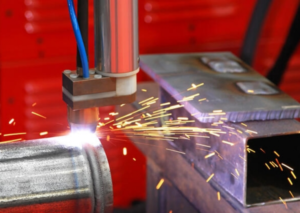
6-Axis Robot Specifications
The 6-axis robotic arm serves as the core of our welding machine, boasting high positioning accuracy, flexible movement, and strong load capacity—all critical for precise, efficient welding operations. The table below outlines its key technical parameters, including positioning accuracy, load capacity, and working radius, to help you understand its technical advantages and practical applications in your production line:
Specification Item | Parameter Value | Description |
Number of Axes | 6-Axis | Featuring full free movement, it can reach any welding angle and position within its working range. This flexibility enables it to handle complex joint shapes, making it suitable for almost all industrial welding tasks—including curved surfaces, irregular workpieces, and special-shaped joints. It performs exceptionally well in both aerospace precision welding and general mechanical processing. |
Repeat Positioning Accuracy | ±0.02-±0.03mm | High positioning accuracy is crucial for consistent weld quality. It complies with AWS D1.1 welding standards, ensuring uniform weld width, stable penetration, and fewer defects such as undercut and porosity. This minimizes rework and guarantees consistent quality for mass production, particularly in auto parts manufacturing. |
Payload Capacity | 4-22kg | It is compatible with various welding torches, wire feeders, and small workpieces. In real-world applications, it handles both light precision welding (e.g., thin plates) and heavy thick-plate welding. Its strong adaptability makes it an excellent fit for diverse industries, ranging from aerospace precision welding to construction machinery heavy-duty welding. |
Working Radius | 1350-2050mm | Its wide working radius reduces the need to move workpieces frequently during welding, accelerating production and minimizing damage from repeated handling. This is particularly beneficial for welding large components like construction machinery structural parts and is also well-suited for shipbuilding thick-plate welding. |
Protective Level | IP65-IP67 | It offers excellent resistance to welding spatter, dust, and moisture, enabling stable operation in harsh industrial environments such as high-temperature and high-dust workshops. This reduces equipment breakdowns and long-term maintenance costs, making it ideal for the construction machinery and hardware manufacturing industries. |
Max Welding Speed | 0.4-10.5m/min | The stepless speed adjustment adapts seamlessly to different welding processes and material thicknesses, balancing high production efficiency and stable weld quality. In practical use, you can adjust the welding speed according to your specific process requirements, whether for batch production or small-batch custom work. |
Power Supply | 380VAC±10% (Three-Phase Four-Wire) | Stable power input is essential for the continuous and reliable operation of the robotic arm. This parameter is compatible with power grids in most industrial countries, eliminating the need for additional power transformation equipment—thus saving you initial investment costs, especially for small and medium-sized enterprises. |
Operating Temperature | -5-48℃ | It adapts well to diverse environments, operating normally in both low-temperature and high-temperature workshops without additional temperature control. This expands its applicability across different regions and industries, from northern low-temperature factories to southern high-temperature workshops. |
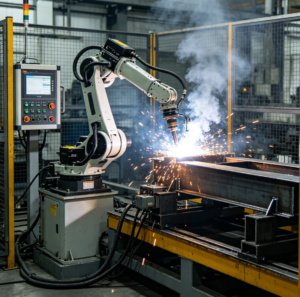
Welding Processes Supported
Our robotic welding machine is compatible with all mainstream welding processes, featuring easy process switching and professional parameter optimization. It meets the welding needs of different materials, workpieces, and industries, with each process rigorously tested in real production to ensure stable quality and high efficiency—perfectly suited for the diverse demands of modern global manufacturing. Based on the aforementioned parameters, the main welding processes it supports are as follows:
MIG/MAG Welding: Also referred to as gas metal arc welding, it is widely used for welding carbon steel, stainless steel, aluminum alloy, and other common metals. Compliant with AWS D1.1 welding standards, it offers fast welding speed, large deposition volume, and clean welds—making it ideal for batch welding of thick plates, large workpieces, and structural parts. The integrated digital power supply supports single and double pulse modes, which reduce welding spatter and post-welding polishing work, helping you significantly cut labor costs. This is a practical feature for most manufacturers, especially those in the hardware and kitchenware sectors.
TIG Welding:
Also known as gas tungsten arc welding, it is primarily used for precision welding of thin plates, high-alloy steel, and non-ferrous metals such as copper and titanium. It features a small heat-affected zone, high welding precision, and neat welds, making it popular in high-precision manufacturing fields like aerospace, electronic equipment, and medical devices. It meets the strict quality requirements of high-end products, and many aerospace companies utilize this process with our equipment.
Laser Welding:
Integrating laser technology with robotic welding, it boasts high energy density, fast welding speed, and minimal thermal deformation. It is suitable for precision welding of micro-components, thin-walled workpieces, and special materials like titanium alloy. The built-in laser positioning system automatically adjusts for workpiece deviations, ensuring welding accuracy and reducing manual adjustment time—this accelerates production and improves product qualification rates in practical use. It is an excellent fit for the aerospace and precision manufacturing industries.
Arc Welding:
Equipped with advanced arc tracking technology, it automatically corrects weld seam deviations caused by workpiece clamping errors, thermal deformation, or material differences—ensuring stable welding quality even in complex working conditions. It supports multi-layer and multi-pass welding, meeting the thick-plate welding needs of the construction machinery, shipbuilding, and other industries. It guarantees sufficient weld penetration and structural strength, complying with relevant industrial welding standards.
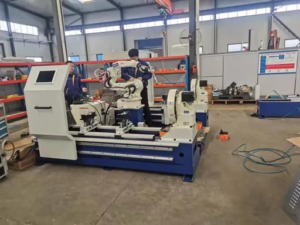
Programming & Integration
To enhance equipment usability and integration flexibility, we have designed it with user-friendly programming methods and seamless compatibility with your existing production systems. This helps you achieve automated transformation quickly with minimal technical investment—ideal for small and medium-sized enterprises embarking on their smart upgrade journey. Once your operators master the basics, they can put the equipment into use rapidly, with no long adaptation period.
Programming Methods:
We offer two programming modes to cater to different operators. Teach pendant programming is simple and intuitive—even operators without professional programming experience can manually set welding paths and parameters, mastering the basics within 1-2 days. Many of our customers have shared that this programming mode is much easier to learn than they anticipated. Offline programming software supports 3D model import, allowing you to simulate paths, set parameters, and check for collisions on a computer—eliminating the need to halt production for on-site programming. For multi-variety, small-batch production, it reduces changeover time to less than 25 minutes, and the built-in AI process package automatically optimizes welding parameters, enhancing programming efficiency and weld quality.
Integration Capabilities:
Equipped with multiple communication interfaces (CAN, Ethernet, RS485), the equipment integrates seamlessly with welding power supplies, wire feeders, fixture systems, and quality inspection equipment to form a complete automated welding line. In real production, it can also connect with AGV robots to automate workpiece transportation, loading, welding, and unloading—achieving full-process automation. It is also compatible with more than 15 mainstream welding machine brands, enabling cost-effective upgrades for enterprises that already have welding equipment. Our customers with existing equipment highly value this user-friendly design.
Applications
With its flexible adaptability, high precision, and stable performance, our robotic welding machine is widely used in various manufacturing industries worldwide. It solves the challenges of manual welding and improves production efficiency and product quality—proven by numerous real-world application cases. Combined with the aforementioned welding processes and programming capabilities, it adapts to the needs of different industries, as detailed below:
Automotive Manufacturing:
Designed to meet automotive manufacturing requirements, the high-precision 6-axis robotic arm ensures accurate welding of complex workpieces, reducing auto part weight and enhancing vehicle safety and durability. In real applications, it has helped 3 leading auto parts companies weld over 1 million workpieces, increasing weld qualification rates to 99.3% and boosting production efficiency by 4 times. This data demonstrates its practical value in automotive manufacturing, and many auto parts manufacturers choose our equipment for its high stability.
Construction Machinery:
Tailored to the needs of construction machinery manufacturing, it is suitable for welding structural parts such as excavators, loaders, and cranes. It supports multi-layer and multi-pass welding of thick plates, with sufficient penetration and stable quality—improving machinery structural strength and service life. Its IP67 protection level resists high concentrations of welding spatter and dust, making it perfect for the harsh working conditions of the construction machinery industry. In practical use, it has an extremely low failure rate in this sector.
Hardware & Kitchenware Manufacturing:
Customized to the needs of this industry, it is used for welding stainless steel kitchenware, hardware tools, and metal furniture. Its flexible deployment and simple operation make it suitable for small-batch and custom production. The lightweight design and mobile workbench allow the robot to move easily to workpieces, avoiding damage from handling and enhancing production flexibility. Many small and medium-sized hardware companies have praised this practical design.
Aerospace & Precision Manufacturing:
Meeting the high-precision requirements of this field, it is used for precision welding of aerospace engine parts, electronic components, and medical devices. High-precision positioning and laser welding ensure stable, accurate welds, meeting the strict standards of high-end manufacturing. The small heat-affected zone preserves the performance of precision parts—critical for high-end products, which is why many aerospace companies select our equipment.
FAQs
We have compiled the most common questions our global customers ask about our robotic welding machine, along with detailed answers. Reviewing these will help you quickly understand the product and resolve any practical issues you may encounter.
Q: What is the service life of the robotic welding machine?
A: The 6-axis robot body is designed to last 8-12 years, with a mean time between failures (MTBF) of over 120,000 hours. Regular maintenance can further extend its service life. Core components such as reducers and servo motors are sourced from well-known brands—this ensures long-term stable operation and lower maintenance costs. It is easy to operate, and with regular upkeep, it will serve your business for many years.
Q: Do I need professional technicians to operate the equipment?
A: No, you do not. The equipment features a user-friendly interface and simple teach pendant programming, making it easy to learn. Most ordinary operators can master basic operation and programming within 1-2 days of training. We also provide free technical training and 24-hour after-sales support to help you resolve operational issues quickly. In fact, many operators without a professional background can get started rapidly.
Q: Can the equipment adapt to non-standard workpieces?
A: Yes, it can. The 6-axis robot has full free movement, and the offline programming software supports 3D model import and path simulation. Allowing it to adapt to non-standard workpieces of different shapes and sizes. The laser positioning function automatically adjusts for workpiece deviations, ensuring welding accuracy. This is a practical feature for custom processing companies, and many of them have benefited from it.
Q: What materials can the robotic welding machine weld?
A: It can weld a variety of metals, including carbon steel, stainless steel, aluminum alloy, copper alloy, titanium alloy. And other common metals. You can select different welding processes based on the material type. And thickness to ensure excellent weld quality and efficiency this is one of its key advantages.
Q: How long does it take to recover the equipment’s investment cost?
A: Typically, the investment payback period is 1.5-3 years. One robotic welding machine can replace 2-5 skilled welders, significantly reducing labor costs. It also minimizes material waste, increasing material utilization by 12%-18%, and boosts production efficiency by 3-5 times. The exact payback period depends on your production volume and application—higher volume results in faster payback.
UVP Module
To help you maximize the value of our robotic welding machine, we provide the following free value-added modules. These modules support your production and application needs, helping you fully leverage the equipment’s capabilities. They are completely free and designed to simplify equipment operation and reduce potential issues down the line.
Spec Sheet:
It includes detailed technical parameters, performance indicators, configuration lists, installation requirements, and maintenance guidelines. You can download it for free to access all necessary product details, which facilitates equipment selection, installation, and daily maintenance.
Process Compatibility Matrix:
This structured document clearly outlines which welding processes are compatible with different materials and workpiece thicknesses. It helps you quickly select the right welding process for your production needs. Avoiding process mismatches, reducing downtime and errors, and improving production efficiency and product quality. It is a valuable tool for any business looking to enhance efficiency.
Reviews
There are no reviews yet.